

With the start of 2026, employers and employees are facing a major shift in workplace regulation across the United States. California, in particular, continues to lead in expanding worker protections, structuring employer obligations, and strengthening regulatory standards through various legislative updates that go over everything, from wages and pay transparency to workplace notices and recordkeeping. Having a full understanding of the new California employment laws is important for maintaining compliance and protecting your rights in the workplace.
1. New Minimum Wage Requirements (Labor Code Section 1182.12)

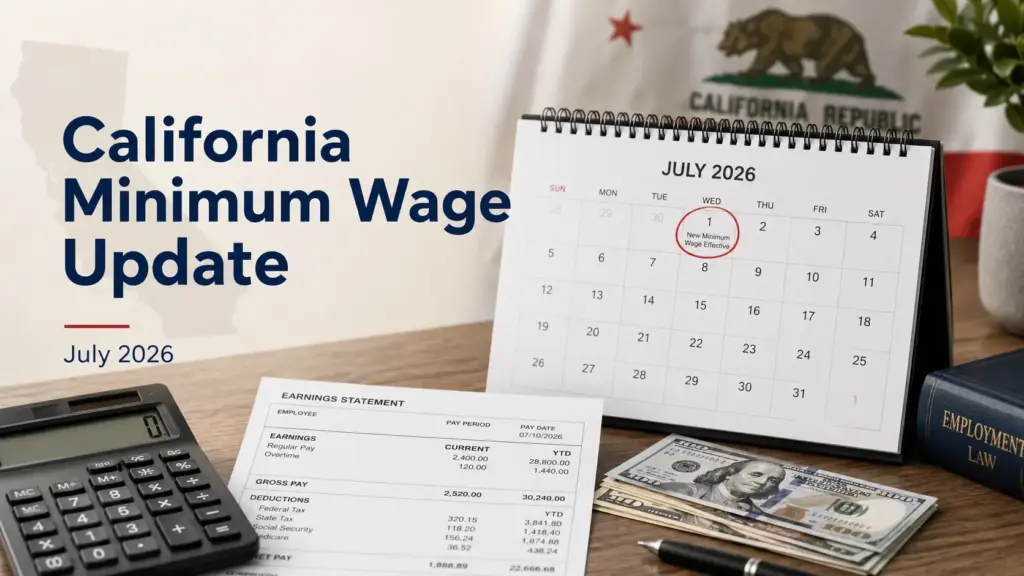
Effective January 1, 2026, California employers must comply with an increased minimum wage of $16.90 per hour, a continuation of existing law that connects wage growth to inflation, but now reflects additional adjustments because of the rising living costs. This also raises the exempt salary threshold, meaning salaried employees will need to meet a higher earnings floor to qualify for exemption from overtime.
In 2026, that formula is calculated as $16.90 × 2 × 40 hours per week × 52 weeks per year, leading to a required annual salary of $70,304. In order to meet the exemption test, employers must ensure that they are paying employees at or above this threshold.
Failure to do so will result in civil penalties and enforcement actions by agencies, like the California Labor Commissioner (DLSE). In some cases, inconsistent pay practices associated with protected characteristics may even constitute unlawful discrimination, particularly where there is actual knowledge of disparities.
2. Equal Pay Enhancements (SB 642)

Under SB 642, transparency requirements have become stricter to ensure job postings reflect reality. Effective January 1, 2026, employers must provide a “good faith” estimate of the salary or hourly wage to a job candidate at the time of hire. This update directs the burden onto employers to disclose accurate pay surrounding an employee’s job duties, job categories, and required core competencies.
The law also expands the definition of wages to consist of:
- Bonuses and profit-sharing
- Equity, stock, and stock options
- Benefits, such as life insurance and vacation and holiday pay
- Allowances (like gasoline or cleaning reimbursements)
The changes impact the annual pay data reporting that employers are required to submit to the California Civil Rights Department (CRD) and This was made to minimize systemic pay gaps and enhance accountability, specifically where disparities could constitute unlawful discrimination.
Employers who provide misleading or inaccurate pay scales or wage range disclosures may encounter civil penalties. This especially applies if enforcement agencies determine there was actual knowledge of false reporting.
3. Ban on “Stay-or-Pay” Agreements (AB 692)

A major update in 2026 targets “stay-or-pay” provisions, which is codified as Section 16608 of the Business and Professions Code. Starting January 1, 2026, this law will ban clauses that force you to pay back training or relocation costs if you leave a job early. Unless a very specific exception applies (like a sign-on bonuses or tuition for transferable credentials), these agreements are now considered void.
Under the existing law, these agreements were not properly regulated and fell into a gray area, allowing some employers to use them in ways that restricted employee mobility. The intent for this adjustment is to protect workers from dealing with financial pressure that could make them feel stuck in a job they want to get out of.
There are a few exceptions where repayment is still allowed, like for sign-on bonuses or tuition for transferable credentials. This is only applicable if certain criteria are met:
- The terms must be in a separate agreement
- Employee will have 5 business days to review it
- Repayment will need to be interest-free and prorated within two years
If employers go against this rule, legal consequences may be inflicted. Employees will be given a private right of action, meaning they may be entitled to sue to recover actual damages or up to $5,000 per worker, in addition to attorneys’ fees. These violations may also trigger additional civil penalties, especially where there is actual knowledge that such agreements are prohibited.
4. Rideshare Sectoral Bargaining (AB 1340)

AB 1340 (the Transportation Network Company Drivers Labor Relations Act) allows rideshare drivers to collectively negotiate wages and working conditions, marking a departure from the existing law, which treated them largely independent and restricted collective price-setting under antitrust rules.
This new law is made to address gaps in worker protections within the gig economy and to provide a structured process for negotiation that is overseen by the Public Employment Relations Board (PERB). The aim is to balance flexibility with fairness, ensuring gig workers are given a voice when it comes to compensation and working standards all while maintaining their status as independent contractors (under Proposition 22).
5. Sexual Assault Claims (AB 250)

As of January 1, 2026, California AB 250 will enforce a two-year “revival” window, lasting through December 31, 2027, permitting adults to submit civil lawsuits that were previously barred by the statute of limitations. This specifically applies to sexual assault claims and related claims (like wrongful termination and sexual harassment) where the defendant engaged in (or attempted) a cover-up of previous sexual assault.
By reopening this limited window, it will give survivors a chance to seek legal action for circumstances that could not be brought forward previously and address the reality that many affected individuals may not come forward because of fear or trauma.
In terms of the workplace, this can overlap with other protections under California Fair Employment framework, specifically where an employer’s actions (or failure to act) could constitute unlawful discrimination or even retaliation. Keep in mind that this revival window does not apply to claims made against public entities.
6. Data Breach Disclosure (SB 446)

Beginning January 1, 2026, SB 446 enforces a much stricter timeline for how California employers must respond to data breaches involving employee or consumer information. With this new update, employers will be required to notify affected individuals within 30 calendar days of discovering (or being notified of) the breach.
This is a big shift from the existing law, which previously required notice to be given “without unreasonable delay.” Furthermore, if a breach affects more than 500 California residents, employers are required to electrically submit a sample copy of the notice to state enforcement agencies, specifically the California Attorney General, within 15 calendar days after notifying the affected individuals.
This change is enforced to close a loophole with the existing law, where delays could leave current and former employees unaware that their personal data has been compromised for months or even longer. Failure to comply with this regulation will result in civil penalties and can be used as evidence of inadequate security practices under the California Consumer Privacy Act (CCPA).
7. Stronger Wage Theft Enforcement (SB 261)

SB 261 introduces stricter consequences for employers who do not pay their workers the unpaid wages they are owed in a wage theft lawsuits, addressing a notable weakness in the existing law, where workers won claims but struggled to collect. Under the existing law, these judgments were treated like low-priority debts, but with this adjustment, if a final wage judgement remains unsatisfied for over 180 days after the appeal period has ended, employers will be met with significantly increased liability, such as a mandatory penalty of up to three times the outstanding judgement amount (in addition to interest).
Additionally, the law presents successor liability, which means that a company cannot avoid these payments by selling assets or restructuring under a new name. The liability now “follows the business.” These changes demonstrate ongoing legal developments that prioritize strengthening post-judgement recovery systems.
8. California Worker Adjustment (Cal-WARN) (SB 617)

The state has updated its California Worker Adjustment and Retraining Act framework (Cal-WARN) through SB 617, expanding what employers must include when giving a notice of mass layoffs, relocations, or terminations. The existing law already requires employers to provide a 60 days’ advance notice. However, this change improves the level of detail that must be presented.
Employers will now need to mention in the written notice whether they plan to coordinate support services, like a Rapid Response Orientation, with a local workforce development board or another organization. If an employer chooses to coordinate these services, they will have to arrange them within a 30-day timeframe from the date of the notice.
The notice must also include more complete, thorough information, like:
- Employer contact details: An active email address and telephone number of the company.
- CalFresh program information: An overview covering statewide food assistance programs, such as the benefits helpline and a link to the official site.
- Rapid response services: A description of the activities provided by the local board to help workers transition and look for new jobs.
The goal is to ensure that affected individuals are not only notified about layoffs, but are also given immediate and direct access to support and public assistance resources in order to lessen the impact of job loss.
9. Workplace “Know Your Rights” Notice (SB 294)

The Workplace Know Your Rights Act requires all California employers (regardless of size) to provide employees with a written notice of workplace protections at hiring and annually thereafter, starting February 1, 2026. This adds to the existing law, which required certain workplace disclosures, but did not enforce a standalone individual notice.
The update ensures employees know about labor protections, unfair immigration-related practices, and their rights during workplace enforcement actions. In addition, the law required employers to give every employee the opportunity to designate an emergency contact by March 30, 2026. Employers are expected to:
- Keep these contacts and allow employees to update them as needed.
- Notify the contact that an employee is arrested or detained at the worksite (or during work hours).
- Do a specific “opt-in” where the employee gets confirmation that they want that person to be notified if an arrest happens.
The intent behind this adjustment is to increase transparency and empower employees with accessible information about their rights. If a company ignores these obligations, they will face civil penalties of $500 per employee. For the emergency contact portion, stakes are higher for the boss as they can be penalized with fines of $500 per day, which is up to a $10,000 maximum per worker if they choose not to comply with these rules.
10. Stronger Wage Enforcement Protections for Farmworkers (SB 846)

SB 846 updates how wage claims are managed for agricultural workers, making it easier for them to recover unpaid wages by modernizing the state’s “crop lien” laws. Under the existing law, farmworkers had to go through a longer and more difficult legal process to collect what they were owed.
The update strengthens the role of the Labor Commissioner, who is required to act on these specific lien claims within 10 days of filing. Once the lien is filed, it stays in force for 45 days. The goal is to make wage enforcement accessible and effective, especially in cases where workers do not have the resources to file claims on their own. By providing a direct tool to “freeze” the value of the crops worked on, the law ensures workers are properly compensated and closes gaps that permitted agricultural theft to go ignored for years.
11. Enhanced Enforcement Against Workers’ Compensation Noncompliance (SB 847)

SB 847 aims to make sure injured workers are given their full workers’ compensation benefits, like medical treatment and disability payments, even when an employer is illegally uninsured. California law already requires employers to carry insurance so employees are able to access these benefits right after they suffer an injury. But, some uninsured employers tried to avoid their reimbursement obligations to the state by either moving or hiding assets, like real estate, after an injury happened.
This new update closes that gap by authorizing the state to make a “prima facie” determination that a property transfer was made to avoid accountability. If an employee transfers assets to an insider, like a family member or a related business, without fair payment, the state will treat those assets as a “resulting” trust that is available to cover the cost of the workers’ benefits. Basically, employers cannot avoid liability by shifting property behind the scenes.
The intent is to protect the financial stability of the Uninsured Employers Benefits Trust Fund (UEBTF) and make sure workers are not left without cover during their recovery process. It also ensures fairness for the majority of employers who comply with the rules. If employers fail to follow such regulations, they will be met with civil penalties and the immediate attachment of liens to their property to cover the full cost of workers’ compensation benefits that are owed to the affected employee.
12. Expanded Leave Protections (AB 406)

AB 406 expands when employees can take protected time off from work when faced with situations involving crime or legal proceedings. Meaning, that beginning of 2026, employees can use their paid sick leave to attend judicial proceedings, seek medical or psychological care, or engage in safety planning.
While employees already had limited protections to fulfill certain activities, like jury duty, this law integrates and enhances those rights under a new “Qualifying Acts of Violence” framework. This allows employees to use unpaid, job protected leave and accrued paid sick leave if they (a family member or someone who is equivalent of a family member) are victims of a crime. This includes:
- Violent felonies
- Crimes involving dangerous weapons
- Any act triggering physical injury or a threat of injury
The reason for this update is to make sure employees do not have to choose between their job and managing safety or legal obligations. Employers are prohibited from inflicting disciplinary action, like firing, or discrimination against workers for exercising such rights. In addition, employers with 25 or more employees may be required to provide reasonable safety accommodations, like changing a work phone number or installing new locks, to protect a victim in the workplace.
13. Artificial Intelligence & Workplace Liability (AB 316)

AB 316 (also known as the AI No Defense Act) addresses how artificial intelligence (AI) is used when it comes to real-world situations. Previously, companies and individuals could argue that harm was caused by the “autonomous” or “unforeseeable” nature of an AI tool rather than their own actions. This caused some confusion around responsibility, especially when AI became more common for hiring, evaluations, and decision-making.
This new regulation (codified as Civil Code Section 1714.46) brings in clarity by prohibiting defendants from claiming that an AI system acted autonomously as a defense against liability. If a company developed, modified, or used an AI system that ultimately led to harm, they cannot form arguments claiming that the AI “did its own things.”
Businesses across all sectors will still remain legally accountable for results coming from the technology they deploy regardless of how independent the system seems to be. This law reinforces that the duty of care will remain with humans and businesses using the technology, ensuring that employers will not be able to hide behind the machine for any AI-based errors.
All in all, AB 316 sends a distinct message: using AI does not minimize responsibility, it increases the legal need for human oversight and strict risk management.
Protect Your Rights Under the New 2026 Laws

With California rolling out new employment laws in 2026, employees will start to notice changes when it comes to pay transparency, workplace protections, and employer compliance obligations. While these adjustments are made to promote fairness and accountability, they can also lead to some confusion. Understanding how these laws work is important to ensure your rights are protected and you are being treated fairly in the workplace.
At West Coast Employment Lawyers, our team is readily available to provide legal services. We can assess workplace practices, determine potential violations, and seek claims for unpaid wages, penalties, and other types of damages. Our employment attorneys will present available options and advocate on your behalf to ensure you are given the best possible outcome.
To book a FREE consultation, we invite you to reach out to us by calling (213) 927-3700 or completing our quick online contact form.