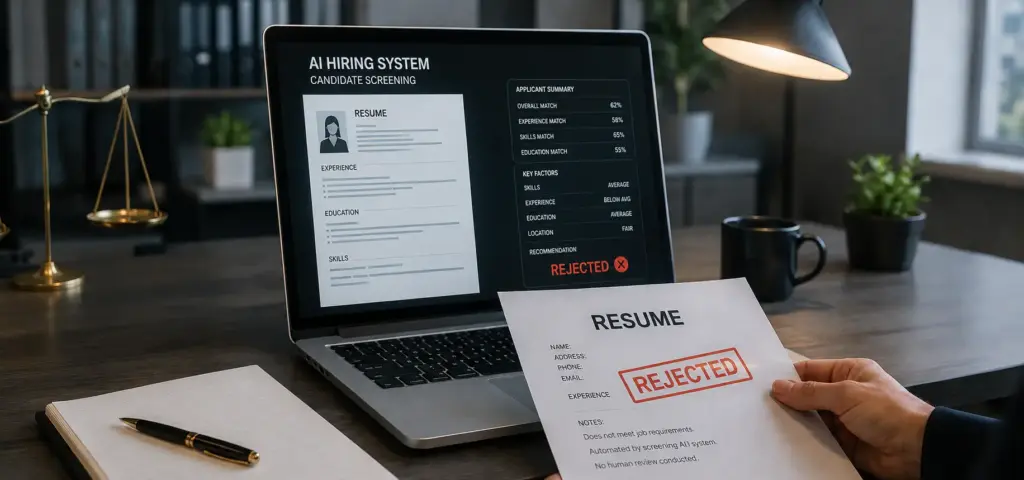
Artificial intelligence is changing the way employers hire, evaluate, promote, and even terminate workers. As more and more employers are using automated systems to screen thousands of resumes, rank candidates, and recommend which applicants should move forward in the hiring process, the question has to be asked: what happens if the algorithm makes a mistake?
That question is at the center of Mobley v. Workday, Inc., an ongoing federal employment discrimination case in the Northern District of California. The lawsuit challenges the use of automated hiring technology and raises an increasingly important legal question: Can the company behind an AI hiring system be held responsible when its technology allegedly discriminates against job applicants?
What Is Mobley v. Workday?

Mobley v. Workday, Inc., Case No. 3:23-cv-00770, was filed in the U.S. District Court for the Northern District of California. The lawsuit began with allegations from Derek Mobley, a Black man over the age of 40 who alleged that he also has disabilities. Mobley claimed that he repeatedly applied for positions at companies that used Workday’s recruiting technology and was rejected despite his qualifications.
His lawsuit alleges that Workday’s applicant-screening tools discriminated against applicants based on characteristics including race, age, and disability. Naturally, Workday has disputed the allegations and has argued, among other things, that it does not make employers’ ultimate hiring decisions. That distinction has become one of the most important aspects of the lawsuit.
What Makes This Case Different?
Traditionally, an employment discrimination lawsuit is brought against the employer that made the discriminatory decision. However, if an employer purchased technology or a service from that is conducting unlawful conduct such as an AI program instantly rejecting applicants because of their age and disability status, it may establish legal precedent for future AI discrimination lawsuits.
For California workers and job applicants, the issue is especially significant. As of October 1, 2025, California regulations expressly clarify that the state’s employment discrimination laws apply when employers use artificial intelligence, algorithms, and other automated-decision systems. The question therefore becomes: Who is responsible when the technology itself allegedly contributes to discrimination?
Why Mobley v. Workday Is Important

In July 2024, U.S. District Judge Rita F. Lin allowed significant portions of Mobley’s case to continue. The court concluded that Workday could potentially be liable as an employer’s agent when its software performs functions traditionally performed by employers, such as screening and recommending which candidates should advance in the hiring process.
The ruling did not determine that Workday actually discriminated against Mobley. Instead, it allowed important portions of the case to proceed. This distinction matters, because if technology companies could never face liability because they are technically not the applicant’s prospective employer, there could potentially be a significant accountability gap.
What Are the Latest Updates to Mobley v. Workday?
In 2025, the court granted preliminary collective certification concerning certain age-discrimination claims, allowing similarly situated applicants age 40 and older to pursue claims collectively under the Age Discrimination in Employment Act.
In March 2026, Judge Lin also granted in part and denied in part another Workday motion to dismiss, allowing portions of the litigation to continue. Discovery remained active in May 2026, when the court issued an order addressing requests for Workday’s bias-testing, applicant, EEO-1, and federal contractor-related records.
As of August 2026, the case remains ongoing. The allegations against Workday have not been finally proven, and the court’s procedural rulings should not be confused with a verdict finding Workday liable for discrimination.
How Can an Algorithm Discriminate If It Does Not Know Your Race?

This is one of the most important misconceptions surrounding AI discrimination. An algorithm does not necessarily need a field labeled “race,” “age,” “sex,” or “disability” to produce outcomes correlated with those characteristics. AI systems work by identifying patterns in information, meaning there are other variables that can sometimes function as proxies for protected characteristics.
For example, if the most historically successful employees at a company were disproportionately younger workers, an algorithm will identify candidates who resemble those previous employees and try to produce an outcome with similar results, but will disproportionately exclude applicants over 40.
Can an Algorithm Discriminate Based on Other Information?
An algorithm can potentially discriminate candidates based on other data points, especially any information that is associated with the following:
- ZIP codes or geographic location
- Schools attended
- Employment gaps
- Graduation dates
- Language patterns
- Speech patterns
- Disability-related behavior
- Previous salary
- Length of employment history
Research has also demonstrated that language models can exhibit biases associated with dialect. One published study from Springer Nature found that language models displayed negative stereotypes associated with African American English and could produce different hypothetical employment recommendations based on dialect.
This is why eliminating explicit references to protected characteristics does not necessarily eliminate algorithmic discrimination.
What Should You Do If You Suspect AI Discrimination?

Proving AI discrimination can be complicated because much of the important information may be controlled by the employer or their technology vendor. As such, preserving the information available to you is particularly important and here are some things you can do.
- Save the Job Posting– Take screenshots or save a PDF of the original job advertisement and preserve information about qualifications, salary range, location, experience, and job responsibilities.
- Save Your Application Materials– Keep the exact resume and cover letter you submitted and preserve any emails, rejection notices, and communications with recruiters.
- Document How Quickly You Were Rejected- If you submit an application late at night and receive a rejection almost immediately that information could potentially help establish that an automated process was involved. While an immediate rejection does not by itself prove discrimination but documenting the timing can still be useful.
- Identify the Technology Being Used- Look at the application portal, privacy notices, assessment instructions, emails, and URLs. They may identify the applicant tracking system, assessment company, recruiting platform, or other technology vendor involved.
- Look for Patterns Rather Than One Rejection- If you notice that you repeatedly receive immediate rejections from employers using the same platform while receiving interviews for comparable positions through other application systems, that may establish evidence of a pattern.
What Mobley v. Workday Could Mean for the Future of Employment
For decades, discrimination litigation largely focused on the conduct of supervisors, recruiters, executives, and HR departments. With Mobley v Workday, courts may also need to examine algorithms, training datasets, scoring systems, software vendors, and automated recommendations to see if people’s rights are being violated by a thin technicality.
As the case represents a larger shift in employment law, it becomes important for employees to ask questions such as:
- What information was the algorithm trained on?
- Which factors did it consider?
- Were certain variables proxies for protected characteristics?
- Did applicants from one protected group receive systematically lower scores?
- Did the employer test the system for disparate outcomes?
- Could recruiters override the algorithm?
- Did a human actually review the applicant?
- What records exist showing how the decision was made?
Those questions illustrate why Mobley may become an influential case even if the litigation ultimately resolves without a trial.
Speak With a California Employment Attorney About Suspected AI Discrimination

Applicants and employees usually cannot see how an employer’s algorithm works. While that lack of transparency can make AI discrimination difficult to recognize and even harder to prove without further investigation, if you believe an employer’s automated hiring discriminated against you because of a protected characteristic, it may be worth consulting with an labor attorney to see if you have a case.
At West Coast Employment Lawyers, our team of labor attorneys can evaluate the circumstances and assess whether additional evidence could potentially establish that an automated system contributed to unlawful discrimination.
Call us today at (213) 927-3700 or fill out our online contact form today!