Employees sometimes use the words protest, walkout, picket, and strike interchangeably especially during a stressful period in the workplace. However, those activities can have very different legal consequences and meanings.
Whether a group of employees are leaving work to demand higher wages or to attend a political demonstration on their day off, the distinction matters whether an employer can lawfully discipline their employees. In this guide we break down the difference so you can make smart choices before you risk your job.
Quick Answer: The Differences Between a Workplace Protest and a Strike
The simplest distinction is the purpose of the activity and its relationship to employment.
What Is a Strike?
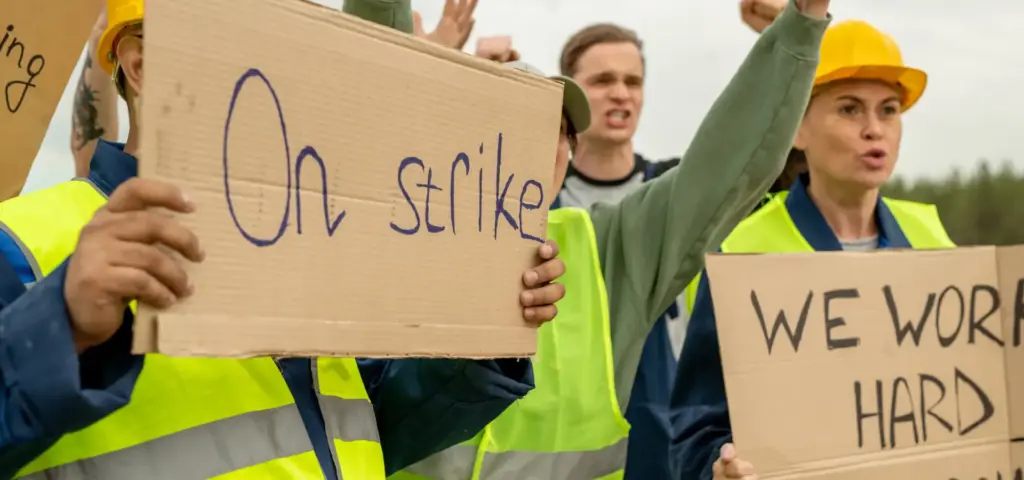
A strike generally involves employees collectively refusing to work as a means of placing pressure on their employer. Section 7 of the National Labor Relations Act (NLRA), codified at 29 U.S.C. § 157, protects the right of covered employees to engage in concerted activities for collective bargaining or other “mutual aid or protection.” During a strike workers may gather and address over issues such as:
- Proposed wage increases
- Work schedules or mandatory overtime
- Health benefits and safety concerns
- Discipline of employees
- Workplace policies and conditions
- Collective bargaining disputes
- Alleged unfair labor practices
- Union recognition or representation issues
Importantly, employees do not necessarily have to belong to a union to receive protection under the NLRA. The National Labor Relations Board (NLRB) states that federal law protects many employees who band together to address workplace concerns even when they are not represented by a union.
What Is a Protest?
A protest is generally an activity intended to express opposition, support a cause, raise public awareness, or influence political or social decision-making.
Examples can include:
- Attending a political march
- Participating in a civil-rights demonstration
- Attending a rally concerning immigration policy
- Demonstrating over environmental policies
- Attending a protest concerning a foreign conflict
- Supporting or opposing legislation
- Demonstrating against a corporation’s political position
- Participating in a community demonstration
Unlike a traditional labor strike, a political protest does not necessarily concern wages or working conditions and often happen outside the workplace, and they may or may not involve coworkers. That distinction becomes important because the NLRA primarily protects concerted activity relating to workers’ interests as employees.
Why this Difference Matters

California is generally an “at-will” state, but “at-will” does not mean an employer can fire you for an illegal reason. So when you stop working to attend a protest or strike, employers will usually respond with one of three things:
- Discipline (write-ups, suspensions)
- Termination
- Replacement (temporary or permanent, depending on the type of work stoppage and other factors)
Whether that response is legal often depends on whether what you’re doing is considered protected activity under federal labor law (like the National Labor Relations Act in many private-sector workplaces) and/or California protections (especially when politics, retaliation, or workplace rights are involved).
What Makes Something a Strike (Legally and Practically)
In most workplaces, a strike is tied to employment conditions. Examples include walking out because:
- Wages aren’t fair
- Overtime is unpaid or miscalculated
- Breaks are being denied
- Conditions are unsafe
- A coworker was disciplined in a way workers believe is unfair
- Workers are demanding bargaining recognition or contract changes (common in union contexts)
Often, strikes are connected to collective action—employees acting together to improve working conditions. That’s why the NLRB’s “concerted activity” concept can come into play in many private-sector situations. If your workplace problem involves wage-and-hour violations or any other common labor code violation, it is best to consult with an attorney to understand your legal options.
What Makes Something a Protest
A protest is usually about political or social issues rather than your employer’s wages or workplace policies. Examples include participating in:
- A march related to social justice or political issues
- A rally supporting (or opposing) legislation
- A demonstration about international events, climate issues, or community concerns
- A public event urging a company or public figure to change behavior (not necessarily your employer)
In California, political activity can sometimes be protected as per California Labor Code § 1101 and California Labor Code § 1102 especially when an employer tries to control or coerce political affiliations or political activity. If you’re specifically wondering about consequences for attending a protest, we covered that here: Can You Get Fired for Going to a Protest?
When Can a Protest Become a Strike?

This distinction becomes particularly complicated when employees organize a walkout. Whether the activity is legally analyzed as a labor protest, protected concerted activity, or a strike may depend largely on what they are protesting.
Example: Protest Over Wages
If employees leave work together and demand a $3 hourly raise, this event may be classified as a strike rather than a “protest” due to the coordinated refusal to work in support of wage demands.
Example: Workplace Safety Walkout
Workers who collectively leave a workplace because they believe dangerous working conditions are placing employees at risk could implicate a protected concerted activity and other workplace-safety protections. The NLRB expressly identifies participating in a concerted refusal to work in unsafe conditions as an example of potentially protected concerted activity.
Example: Political Walkout
Employees who leave their jobs during scheduled hours to participate in a demonstration concerning foreign policy may be treated differently under federal labor law because the activity may not involve workers acting for their mutual aid or protection as employees.
California political-activity protections could still require separate consideration, but those protections do not necessarily eliminate legitimate attendance or workplace-conduct rules.
Can an Employer Retaliate Against Workers for Protected Collective Activity?

Generally, employers covered by the NLRA may not retaliate against employees because they engaged in protected concerted activity. Potential retaliation may include:
- Termination
- Suspension
- Demotion
- Reduced hours
- Unfavorable reassignment
- Threats of termination
- Loss of benefits
- Selective discipline
- Increased scrutiny
- Threatening employees because they discussed workplace issues
- Coercively questioning workers about protected activity
Section 8(a)(1) of the NLRA prohibits employers from interfering with, restraining, or coercing employees in exercising their Section 7 rights. If your employer is punishing you in a way that feels like payback for speaking up (whether it’s political or workplace-related), it is highly recommended to consult with a skilled labor attorney.
A Quick Checklist Before You Join Anything
Before you participate in a protest, walkout, picket, or strike-like action, ask yourself:
- Is this about working conditions or broader politics?
- Are we stopping work during scheduled shifts?
- Are we acting together as employees (collective action)?
- Have we put anything in writing (texts, Slack, flyers) that shows the purpose?
- Are we violating a policy that the employer enforces consistently—or only against certain people?
- Has the employer retaliated before?
- Do we need advice before doing something that could be framed as “misconduct”?
That last point is huge. Employers often try to reframe protected activity as “insubordination” or “performance problems.” The earlier you get clarity, the easier it is to protect yourself.
Speak With a California Employment Lawyer About Retaliation After a Protest, Walkout, or Strike

Whether an employee participated in a protest or a strike can substantially affect their employment rights. If you were fired, disciplined, demoted, threatened, or otherwise retaliated against after participating in a collective workplace action, a California employment attorney from West Coast Employment Lawyers can review your case and give you the legal guidance you need.
Contact us today (213) 927-3700 or fill out our online contact form and get real answers before your employer turns this into a termination.